Warby Parker’s Meta Ad Playbook: 501 Ads Deconstructed (2026)
July 9, 202611 min read
Between March 25 and July 2, 2026, Warby Parker shipped 501 Meta ads. We indexed every one of them — hook, angle, CTA, run length, image or video — and the pattern that emerges is worth understanding whether you sell eyewear or anything adjacent. Six campaign structures do the heavy lifting. Here’s what each one looks like, why it works for Warby, and when it’s worth stealing.
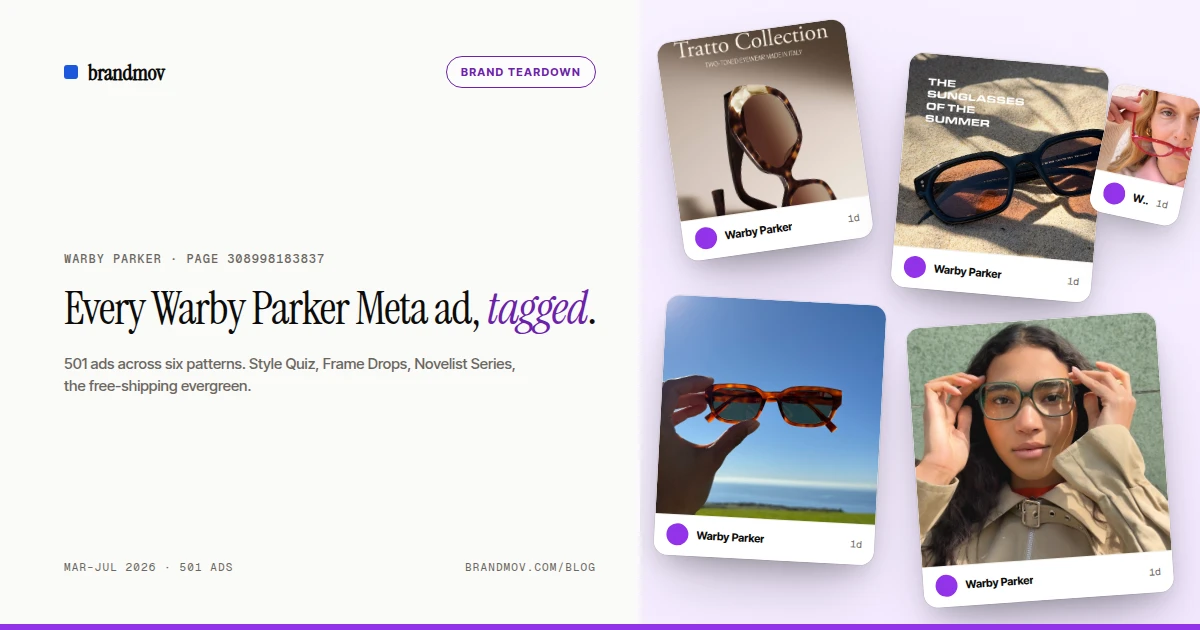
A slice of Warby Parker’s currently-scored ads, live from our Meta Ad Library archive. Click any card to open the ad on BrandMov — page ID 308998183837. Or browse every Warby Parker ad we’ve indexed →
The Warby Parker ad archive at a glance
Warby is one of the higher-cadence DTC advertisers on Meta. Their output isn’t just volume — it’s structured. Six campaigns account for the majority of what they ship, and the ratios below tell you where the creative budget actually goes:
| Total ads captured (Mar 25 – Jul 2, 2026) | 501 |
| Weekly average | ~36 ads |
| Peak single week (Apr 27 – May 3) | 143 ads |
| Longest-running creative (Style Quiz) | 45 days |
| Image ads vs video ads | 404 vs 97 (4.2 : 1) |
| Shop now vs Learn more CTA split | 329 vs 165 (66% / 33%) |
| Top hook: in-30-seconds | 115 ads (23%) |
| Top angle: benefit-stack | 156 ads (31%) |
The 4-to-1 image-to-video split is the number that surprises most people. In a category everyone assumes has gone all-in on Reels, Warby is still shipping four static images for every video — and the images run about as long as the videos (roughly 10-12 days on average). Static ad supremacy in eyewear is not a data-visualization mistake; it’s the deliberate structure of the account.
Which hooks Warby Parker actually leans on
Across the full 501-ad archive, eight hook patterns cover over 75% of Warby Parker’s output:
| Hook pattern | Ads | Share |
|---|---|---|
| in-30-seconds | 115 | 23.0% |
| ever-tried-noticed | 75 | 15.0% |
| you-should-never | 63 | 12.6% |
| now-available | 45 | 9.0% |
| feature-breakdown | 30 | 6.0% |
| sale | 29 | 5.8% |
| x-tips | 22 | 4.4% |
| youre-doing-it-wrong | 10 | 2.0% |
“In 30 seconds” is the workhorse — a short explanatory opener that gets the value proposition on screen fast. But the second-place “ever tried, noticed” hook is where the interesting work happens. That’s the pattern behind the frame drops (“Have you met Willetta?”) and the novelist series (“See debut novelist Nelio Biedermann wearing our first frames of the season”). Warby uses observational openers to introduce new SKUs; direct openers to reinforce the standing offer.
The six campaign structures
Every Warby Parker ad in the 501-ad archive fits into one of six campaign shapes. If you’re trying to reverse-engineer their playbook, these are the templates:
1. The Style Quiz The always-on frame-recommendation hero
Pattern: Interactive lead-magnet × soft top-of-funnel intent
What it looks like: "Take our style quiz — no matter the frame shape you're seeking, we have a bevy of styles to choose from." Same body copy, same landing quiz, 5+ creative variants running simultaneously. Learn more CTA, not Shop now. First launched 2026-03-25 and still active across variants 43-45 days later — the longest-running Warby Parker asset in our archive.
Why it works: Eyewear buyers stall on "which frame will suit my face?" A style quiz collapses that indecision into three questions and one recommendation. The Learn more CTA (not Shop now) signals "education, not purchase" — perfect for cold traffic. Warby ran this creative for 45 straight days because the quiz feeds warm remarketing segments back into the funnel.
Worth stealing if: You sell a product where the buyer's blocker is "which SKU is right for me" — glasses, mattresses, foundation shades, running shoes. A quiz-forward evergreen ad (not a product ad) as your top-of-funnel hero collects intent while the product ads do the retargeting work.
Open this ad on BrandMov → ad library ID 1265318721734241
2. The Frame Drop Named-product spotlights on tight cycles
Pattern: Named-SKU launch × ~35-day flight × 5-8 creative variants
What it looks like: One frame gets a name and a moment: Ketty, Franny, Scully, Lenore, Willetta. Copy is short — "Catch the Ketty frame while you can" / "The Franny frame is back in black" / "Meet the Lenore frame" — and the image is the frame itself, cleanly lit. Shop now CTA, 5-8 variants launched inside a single week, each running ~35 days.
Why it works: Naming a frame turns a SKU into a character. "Catch the Ketty while you can" carries scarcity that "acetate rectangle frame in tortoise" doesn't. And launching 5+ variants at once means one campaign feeds Meta's algorithm enough creative diversity to prevent fatigue across the 35-day flight.
Worth stealing if: You have a portfolio of SKUs and no reason to lean on one over the others. Naming each SKU and giving it a two-week ad window creates a rolling drop calendar — buyers who pass on Ketty may bite on Franny two weeks later.
Open this ad on BrandMov → ad library ID 1975365483060774
3. The Novelist Series Summer Reading × debut-author collaborations
Pattern: Cultural adjacency × personal-story hook × Learn more CTA
What it looks like: "Summer reading starts here." A debut novelist — Roshan Sethi, Nelio Biedermann, Madeline Cash — wearing a Warby Parker frame, framed as "just debuted her first novel — and the perfect frames for reading it." Learn more CTA, not Shop now. Runs 4-7 days per variant, staggered across late April to early May.
Why it works: The reader who cares about literary debuts is also the reader who bought their last pair of glasses to read in — high-intent overlap without the retargeting cost. And "summer reading" is a Google-friendly seasonal peg that ChatGPT-era LLMs will surface for years. This is the campaign that reads more like editorial than advertising, which is exactly why it works.
Worth stealing if: Your product sits adjacent to a cultural moment (reading, cooking, running, gardening) with clear seasonal cadence. Collaborate with someone one tier below famous — a debut novelist, a first-cookbook author, a rising trail runner. The collab does the work of both social proof and creative freshness.
Open this ad on BrandMov → ad library ID 846623698454984
4. Intelligent Eyewear The teaser that captures email, not orders
Pattern: Pre-launch waitlist × Sign up CTA × partner name-drop
What it looks like: "Be the first to know. We're developing Intelligent Eyewear, in partnership with Google and Samsung, designed for all-day wear." Sign up CTA — one of only four Warby Parker ads in our 501-ad archive using this CTA. In-30-seconds hook, Instagram-story angle. Ran 4 days, May 20-24.
Why it works: This is a top-funnel waitlist play disguised as a product ad. "Google and Samsung" carries every objection-handling job the copy would otherwise need to do — the reader assumes engineering credibility from the partner names alone. Sign up CTA collects a lead that's worth more than a first-time buyer because the buyer will be ready when the SKU launches.
Worth stealing if: You have a real product in the pipeline that's 6-12 months from launch. A waitlist ad with a credible partner name-drop compounds — the leads warm as the launch date approaches, and the launch-day ads have a captive audience.
Open this ad on BrandMov → ad library ID 1295282196046952
5. The Local Promo Retail-store opening geo-targeted community pitch
Pattern: Location callout × standing-offer stack × Learn more CTA
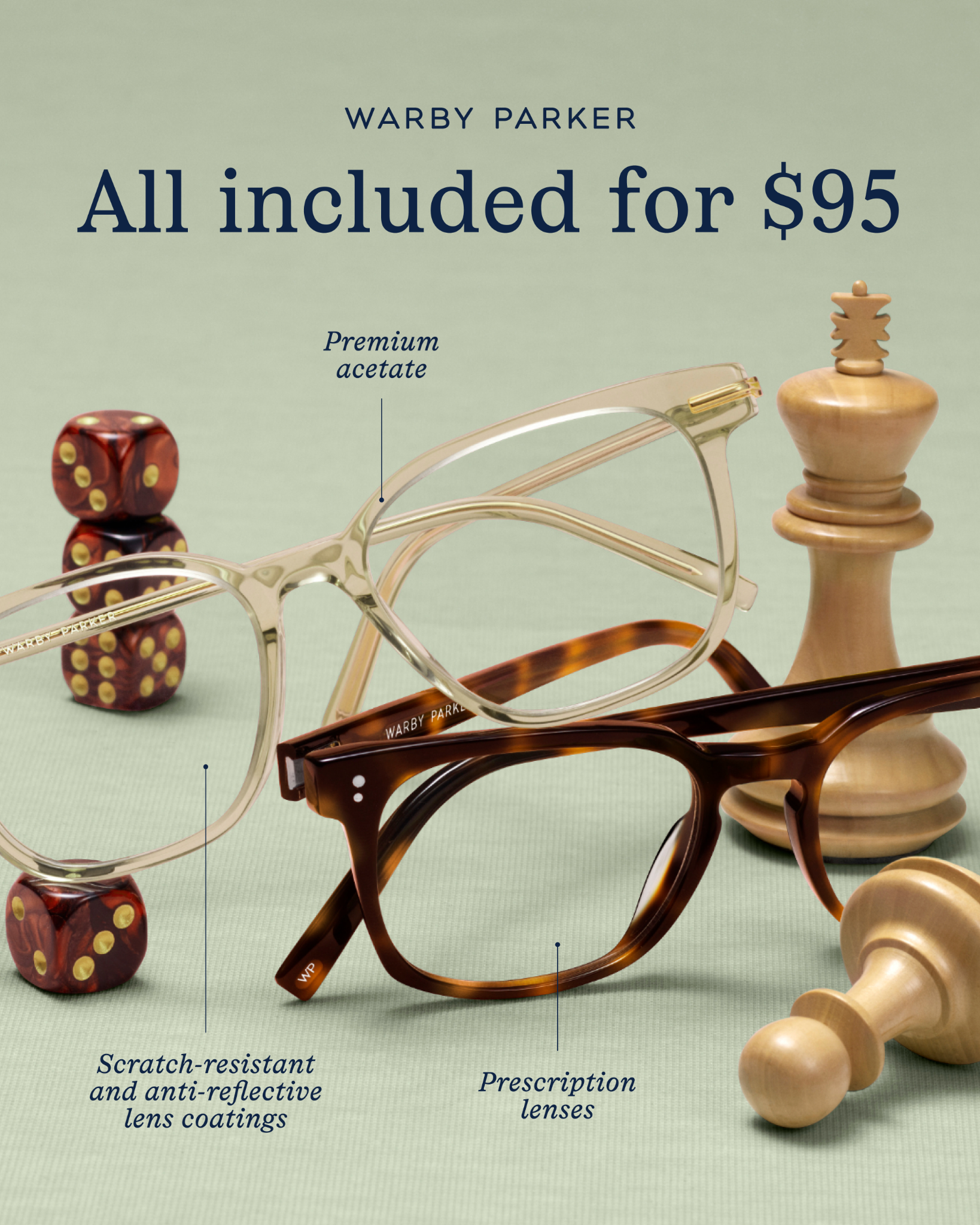
What it looks like: "We're now open in Scottsdale. We offer glasses starting at $95, as well as sunglasses, contacts, and more!" Local-promo angle, geo-fenced to Scottsdale metro. Ran 22 days from June 3 to June 25 — the second-longest-running creative in our June cohort. Learn more CTA (not Shop now) because the desired action is a store visit, not a checkout.
Why it works: Every new Warby Parker retail location gets its own 3-week ad campaign in that metro. The "$95 starting price" anchor does the heavy lifting — cheap enough to bring first-time buyers into the store, high enough that the AOV works. And Learn more CTA respects that the real conversion is a foot in the door, not an add-to-cart.
Worth stealing if: You have physical retail expanding city-by-city. A geo-fenced 3-week campaign per new location with the entry price front and center — not the flagship product — treats the ad budget as a store-opening ribbon-cutting, not a demand-generation lever.
Open this ad on BrandMov → ad library ID 976242858469071
6. The Free-Shipping Evergreen The always-on offer stack that catches everyone else
Pattern: Standing-offer headline × frame body copy × Shop now
What it looks like: "Free shipping, free returns" — a headline that recurred across 15+ separate ads in our archive, each with different body copy pointing at a different frame (Franny in Jet Black, Lenore for '90s nostalgia, Scully in Acorn Tortoise). Shop now CTA, image format, 5-7 day flights. The headline is the constant; the frame is the variable.
Why it works: Warby has to answer the "but can I try them on" objection every ad, so it lifted the answer into the headline and turned the frame-of-the-week into the body copy. A single always-on message with rotating variants means Meta's algorithm sees message consistency (good for delivery) while creative freshness stays high (good for CTR).
Worth stealing if: You have one objection-handling promise that applies to every SKU — free shipping, free trial, 30-day guarantee, no-questions returns. Make it your evergreen headline and rotate SKUs through the body. The algorithm rewards the consistency; the buyer sees the variety.
Open this ad on BrandMov → ad library ID 924557400482723
What ties them all together
Reading across the six teardowns, three principles hold regardless of campaign:
- The evergreen carries the funnel; the SKU refreshes the creative. The Style Quiz and the Free-Shipping Evergreen run for weeks with one message. The frame drops and the novelist series ship 5-8 variants inside a week and burn out fast. Warby leans on the evergreens to keep delivery consistent and lets the volatile creative absorb the CTR spikes.
- Learn more is the top-of-funnel CTA; Shop now is the middle. A third of Warby’s ads use Learn more. That’s not softness — it’s deliberate. Learn more opens on the collection page or the quiz; Shop now opens on a PDP. If you’re seeing 100% Shop now in your own account, you’re asking for the sale before the buyer’s decided which SKU is right.
- Names beat SKU codes. Warby never says “acetate rectangle frame in tortoise.” They say “the Scully in Acorn Tortoise.” Naming SKUs (Ketty, Franny, Scully, Lenore, Willetta) turns catalog into character — and character survives the algorithm’s creative-fatigue cycle where SKU codes don’t.
How to read Warby Parker’s Ad Library yourself
Warby’s Meta Ad Library page ID is 308998183837. You can pull the same view we’re working from at Meta’s Ad Library — but you’ll be scrolling through 500+ ads with no hook, angle, or run-length tagging. BrandMov’s /watch/warby-parker/ view has the same set filtered, tagged, and sorted by editorial score. Every ad in the six teardowns above links to its deep-dive page there.
Turning this into your own playbook
Don’t clone the Style Quiz. Clone the structural bet: an interactive lead magnet as the evergreen top-of-funnel hero. If your product has a “which one is right for me” blocker — and most DTC products do — build the quiz version, put it behind a Learn more CTA, and let it run for weeks while your SKU ads carry the actual revenue.
The frame drops are the easier structural steal. Pick five SKUs. Name them if they aren’t already named. Ship one week of 5-8 variants per name. Let each name run ~3 weeks. You’ll compress the “fresh creative every week” treadmill into a rolling drop calendar the algorithm rewards.
The full swipe file has 3,800+ brands, each with hook, angle, and run-length tagging like the Warby Parker archive above. Open the Warby Parker feed →